


A few years ago, I heard about a distant relative with daughters, all of marriageable age. Word in the marriage market was that he had fixed dowry rates pegged to the groom’s degree: ₹50 lakh for a doctor, ₹30 lakh for an engineer, ₹10 lakh for a B.Com or arts graduate.
That was the father’s plan. His eldest daughter had her own dream: an extravagant wedding with elaborate rituals, friends and a pre-wedding photoshoots. It was as if the story was already written, and she only needed an actor to play it out.
Look closer and the dots connect. She had always been kept close to home. She was never sent away to study and never free to explore. Every request got one of two answers: “Do it after marriage” or “We’re saving for your wedding.” Family and society made her feel that marriage was the checkpoint that would transform her life completely - so she poured all her dreams into that one day.
One thing she wants to show off is her ability to find the dream boy within the constraints of her life. Even though her parents chose him for her, she wants to present him as the one made for her.
The father was trying to find a suitable groom. The daughter was trying to find a love story. They were planning the same marriage, but looking for different things.
On the other hand modern love marriages also search for parents’ approval, for legitimacy, much like arranged ones do.
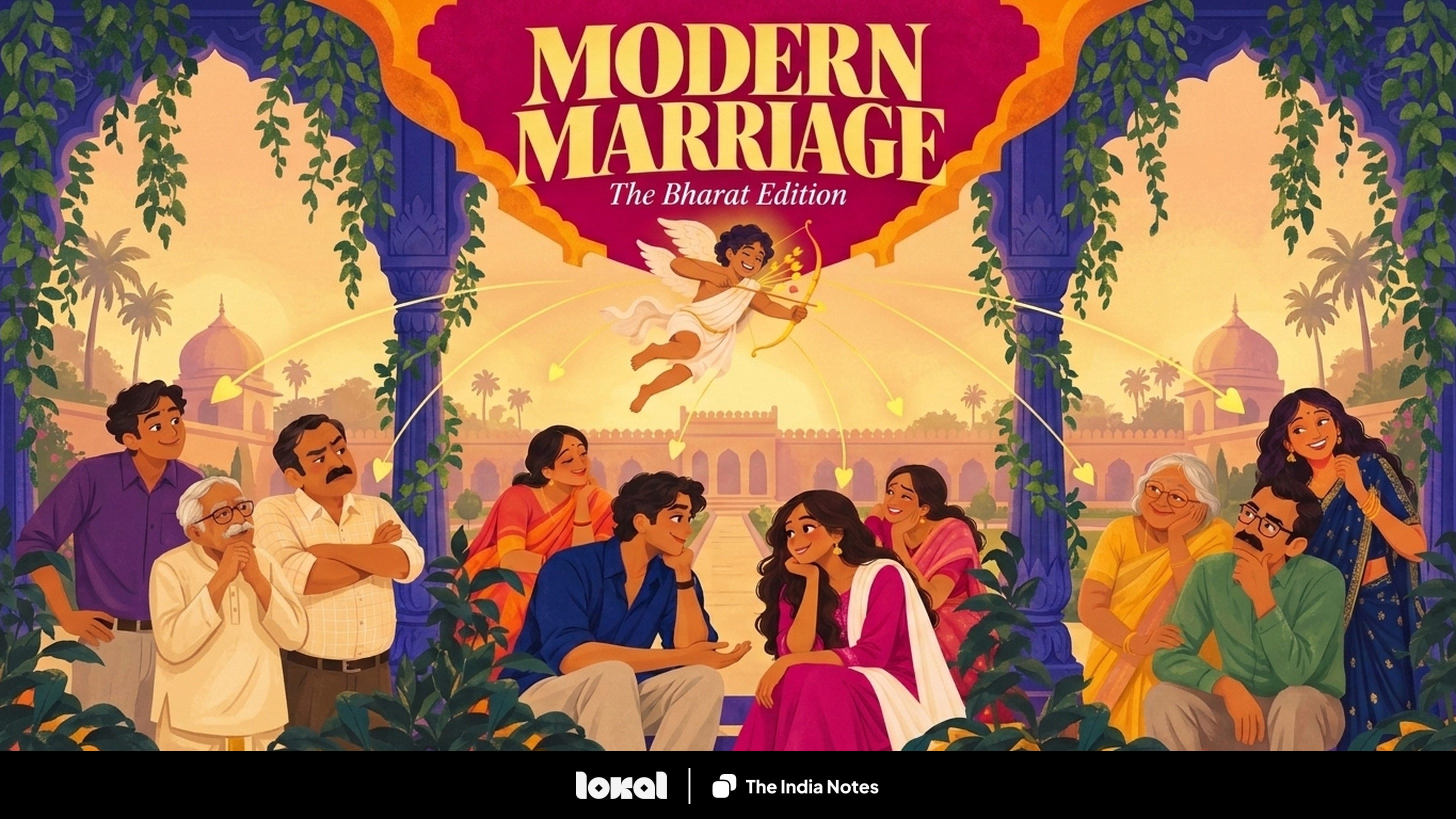
Our newest report, in collaboration with Lokal, explores Modern Marriages in Tier 2 and Tier 3 cities of India. We believe there is a convergence in how arranged marriages and love marriages are happening in India.
If you only have a minute
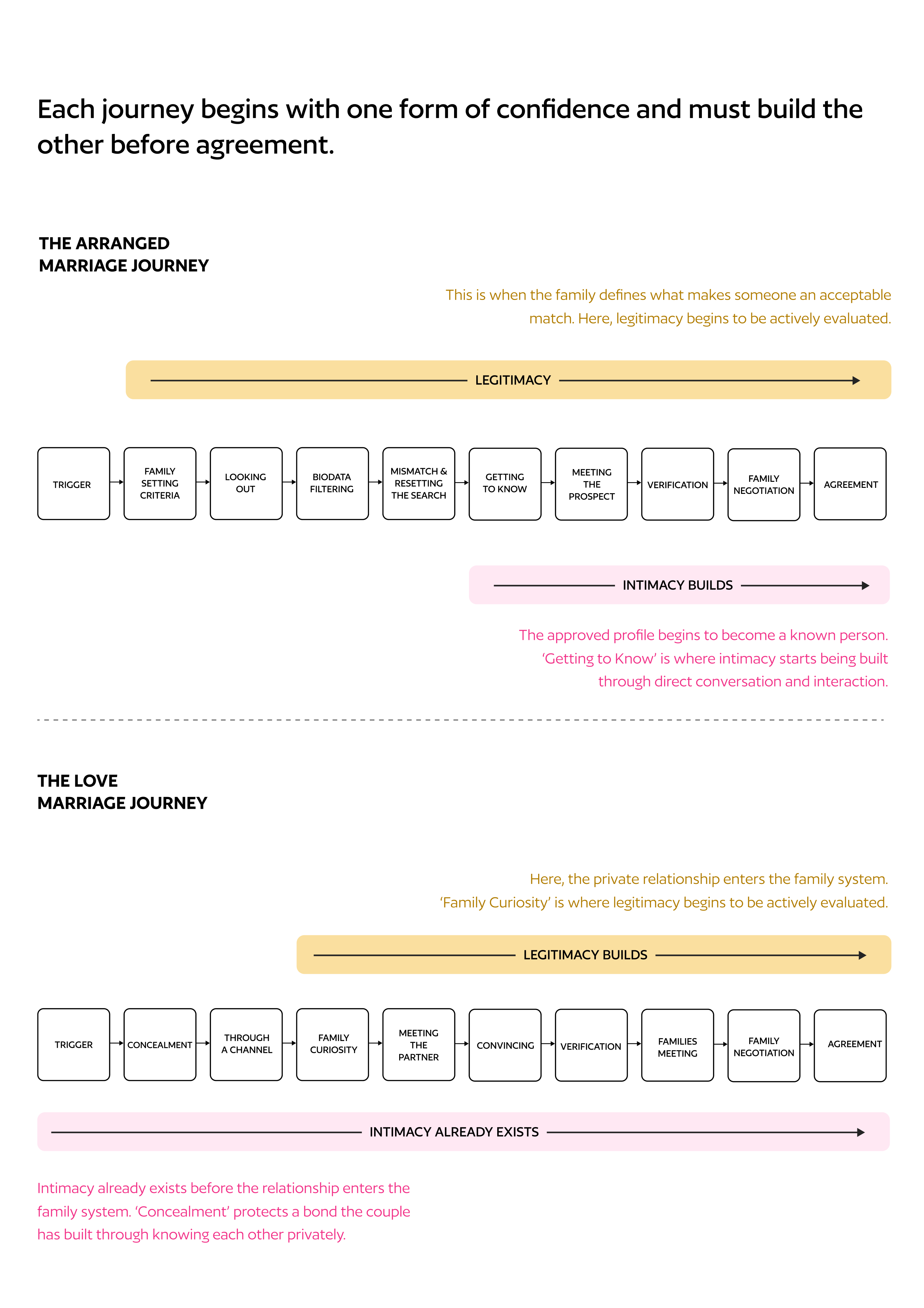
Every marriage in Bharat needs two things: personal connection (knowing the person) and family acceptance (the family agreeing that this person is a suitable match). Call them intimacy and legitimacy.
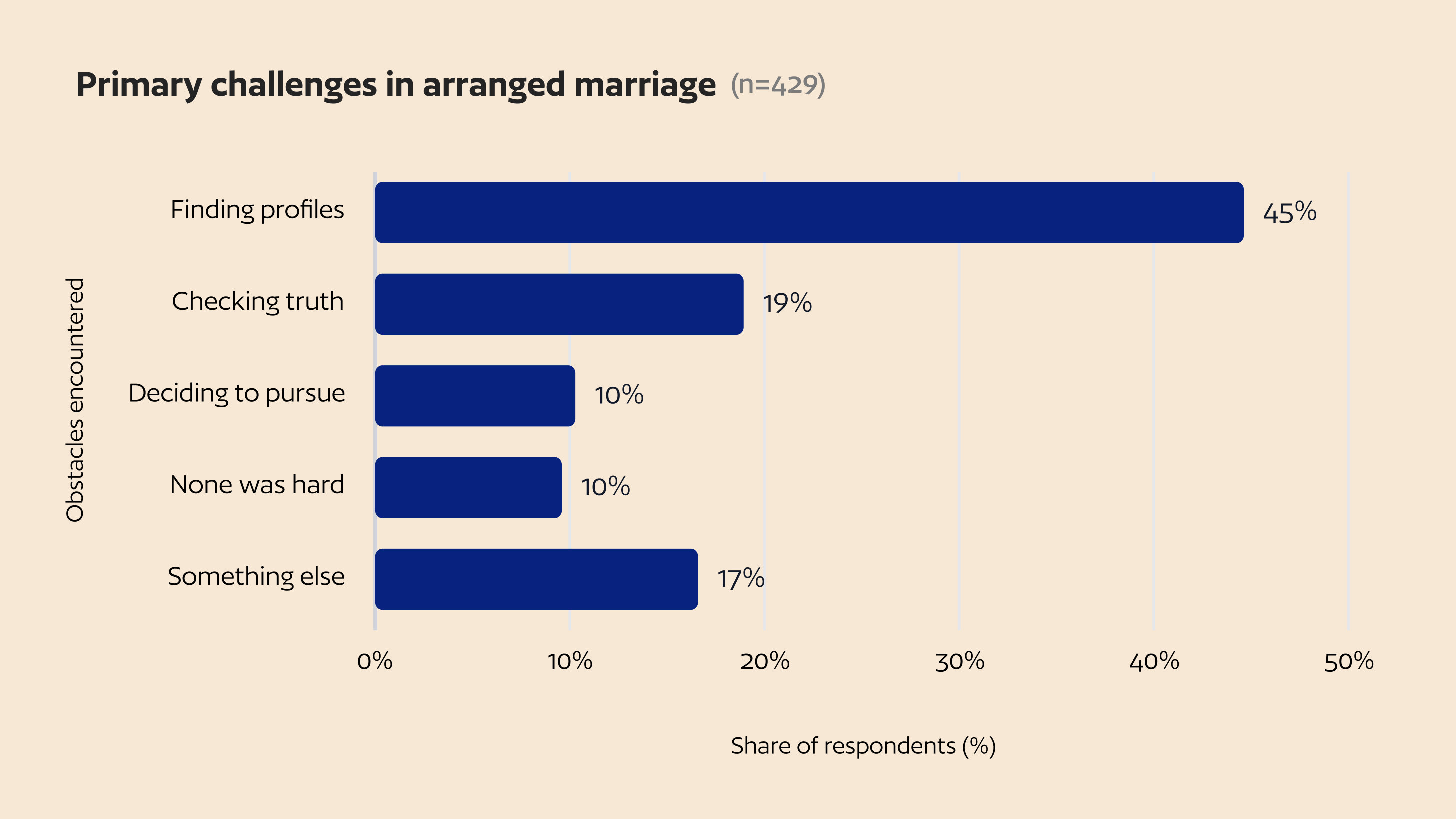
An arranged marriage starts with legitimacy and has to build intimacy. The family approves a profile, and then someone has to turn that approved stranger into a known person. 63% of arranged respondents say finding or checking a match was the hardest part (n=429).
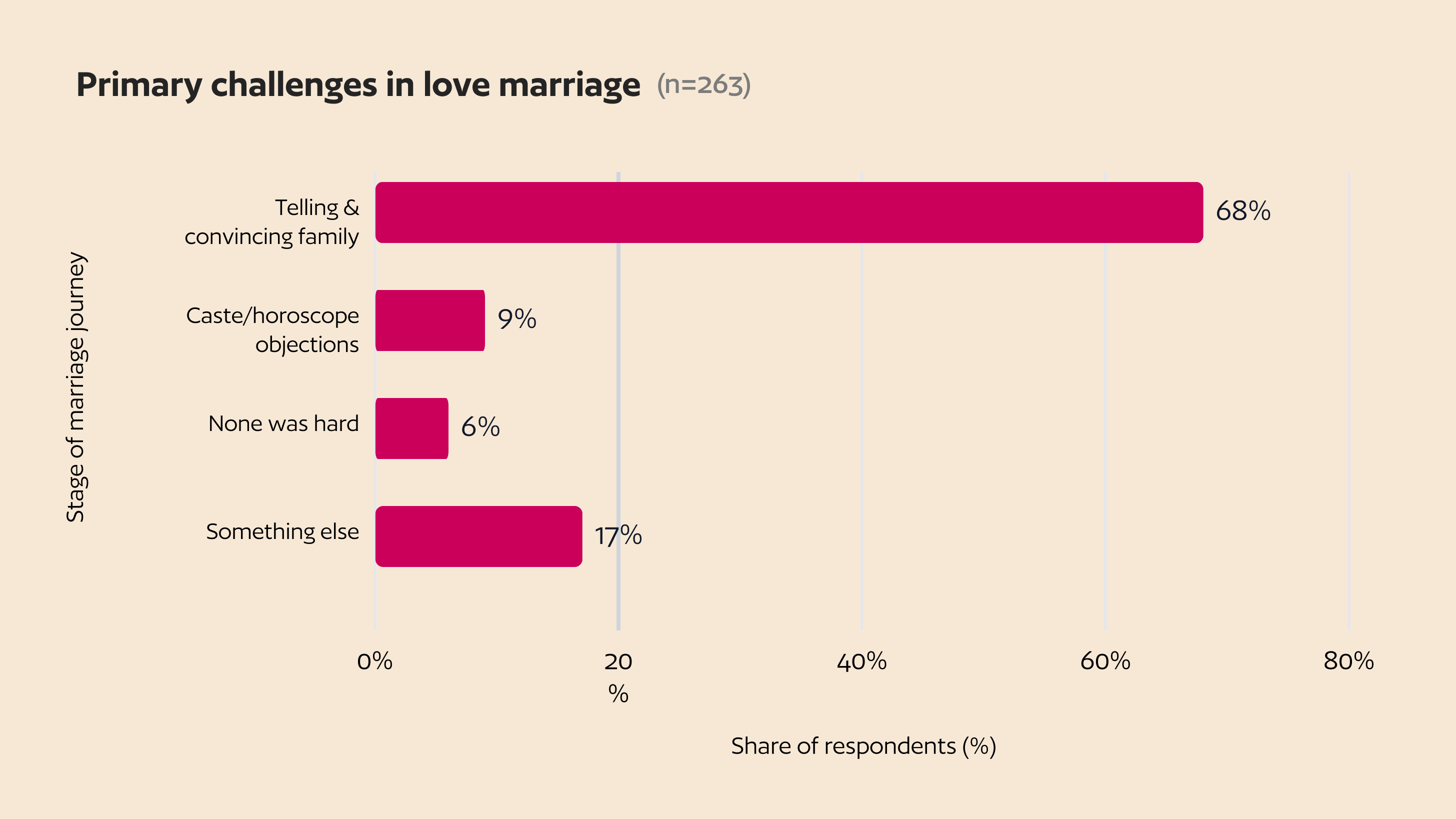
A love marriage starts with intimacy and has to build legitimacy. The couple already knows each other. The hard part is getting the family to see that bond as a marriage. 68% of love respondents say telling and convincing the family was the hardest part (n=263).
Choosing your own partner doesn’t remove the family from the decision. 73% of love marriages still needed a parent’s approval (n=263), led by mothers (56%) over fathers (47%).
Deepthi’s search for a connection
Deepthi is 25 and teaches at a DAV school in Visakhapatnam. Her family has been searching for a suitable match for two years.
Her brother registered her on matrimonial websites. Her aunts and a marriage broker send profiles to her father on WhatsApp. Her father’s criteria are simple: same caste, good family, decent job.
But the final decision is Deepthi’s.
In one case, the boy’s parents visited her home several times. The boy (prospect) never came. Both families discussed the marriage without him.
Her uncle didn’t find this unusual.
“Maybe the boy was not interested. Maybe his parents were checking first.”
Deepthi saw it differently. She didn’t ask why he was absent or request a conversation. She simply rejected the match.
She didn’t know enough about the boy to say yes. But his absence was enough for her to say no.
Phani’s search for family approval
Phani Satya grew up just three houses away from his future wife in Vijayawada.
They had known each other since Class 10, attended the same college, and started dating during his first year of B.Tech. But they kept their relationship a secret from their parents for years. Her sister and his brother knew.
Phani wanted to tell his parents sooner. After all, she was a neighbour his family already knew. Why would they object? She asked him to wait until he had a stable job. She knew her parents would worry about their financial future.
She was right.
When marriage came up, her parents weren’t worried about caste or community. They wanted to know how he would support their daughter. Phani didn’t have a job yet. He completed his B.Tech in 2021 and found a job within two months. Three months later, they married.
Years of knowing each other had convinced the couple. A job was what convinced her parents.
A convergence in love and arranged marriage
Deepthi had her family’s approval but didn’t know the boy. Phani knew the woman he wanted to marry but needed her family’s approval.
Arranged marriages and love marriages may begin differently, but they eventually face the same two questions: Do I know this person well enough? And will my family accept this choice?
This is perhaps what is changing about marriage in smaller Indian cities. Young people want a greater say in whom they marry, but family approval continues to matter.
That’s one of the questions we explored in Modern Marriage: Bharat Edition, a research report by 1990 Research Labs in collaboration with Lokal.
We spoke to young adults and parents across India’s Tier 2 and Tier 3 cities to understand how people find partners, negotiate with families, change their expectations, and eventually decide whom to marry.
The findings surprised us. Not because arranged marriages are disappearing or love marriages are taking over, but because both are changing in ways we rarely talk about.
Read the full report - Modern Marriage: Bharat Edition
This series is built on in-depth conversations, interactive exercises and a multi-state survey with young adults and parents across India’s smaller cities. Over the next six weeks, we’ll explore other questions that emerged from this research, one story at a time including money, caste, dowry, scams, Instagram and expectations shaping India’s marriage expectations.
Because the interesting thing about modern marriage in Bharat isn’t just who gets to choose.
It’s how many people have a say before two people can say yes.
Editor's note: All participant names have been changed to protect their identities and confidentiality.