


Karan Rathi is in his thirties, lives in Jaipur, and has been looking for a bride for five years.
His search has stalled over a single word on his birth chart: Manglik. Every time a biodata arrives, families run the kundli check and move on. His parents did the poojas priests prescribed while relatives taunted them about the delay.
When we spoke to Karan, he didn’t sound angry at astrology. He sounded amused by how selectively it gets applied.
“In a match, if a person has a government job,” he told us, “then they don’t check any horoscope or anything - they quickly finalize the proposal.”
That sentence made us pause for a minute. If a kundli is a cosmic verdict written in the stars, why does a permanent government salary outrank Mars?
Most outsiders look at caste and kundli as ancient, immovable walls waiting to be swept away by smartphones and dating apps. For our report with Lokal, Modern Marriage: Bharat Edition, we surveyed 692 people across Tier 2 and Tier 3 India (429 arranged, 263 love) and interviewed 45 young adults and parents. What we found is far more interesting than a clash between tradition and modernity.
Modern Bharat isn’t blindly obeying ancient rules. It is negotiating them. What looks irrational from the outside is often hyper-rational from inside an Indian household. Caste and kundli act as risk-management tools - ways to price uncertainty, protect children in a low-trust world, and say no without making enemies. And the moment the risk math shifts, the “unbreakable” rules start to bend.
If you only have a minute
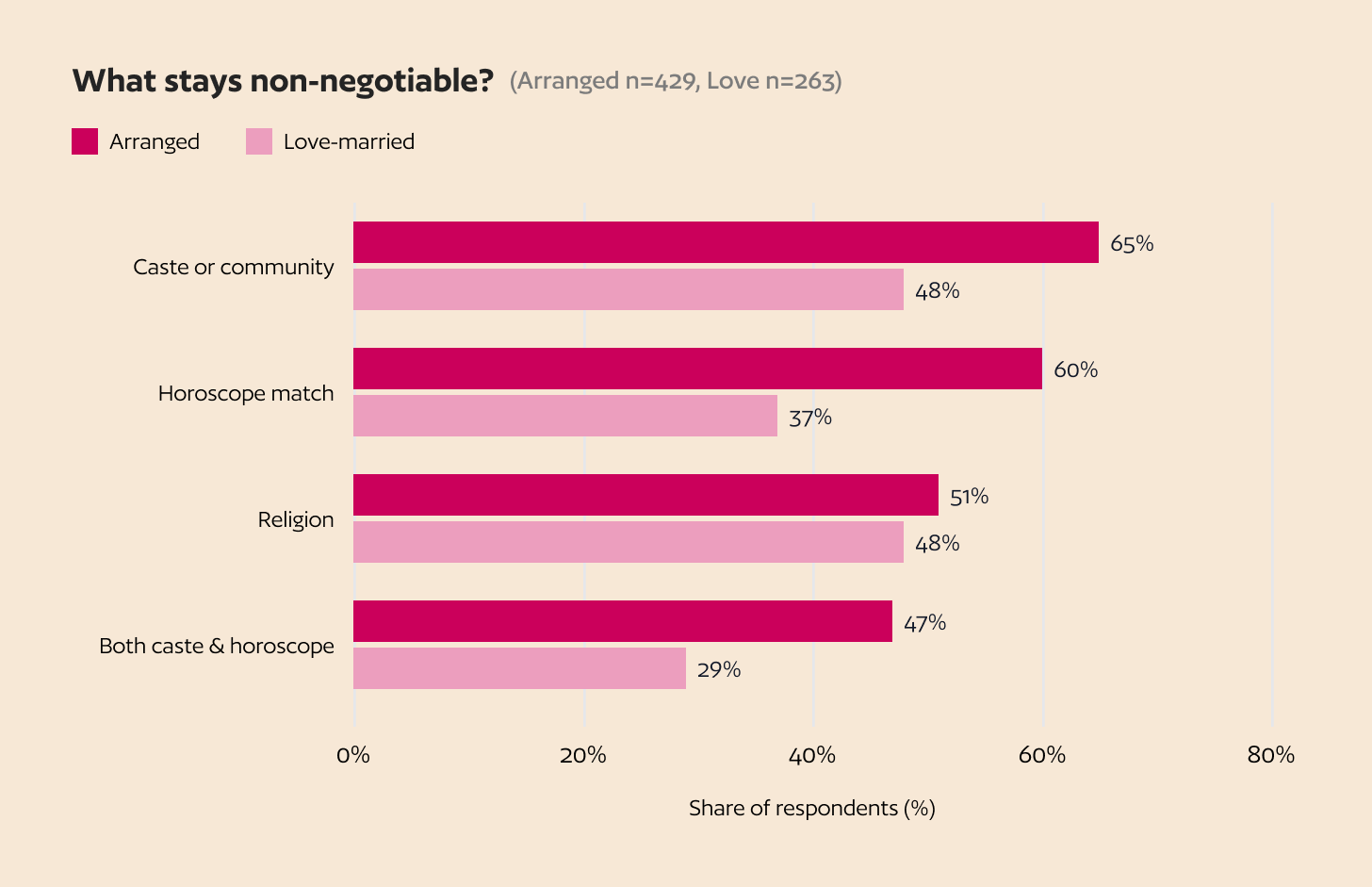
Caste is an insurance policy, not just identity. 65% of arranged and 48% of love-married respondents call it non-negotiable; 97% of arranged-married and 57% of love-married respondents married within their own caste.
Caste stretches with time, until it hits a floor. Long searches widen from sub-caste to adjacent communities - yet almost every “open” family still stops at certain castes and religion.
Kundli is Gate 1 in arranged search - and a polite excuse to rject. 60% of arranged respondents treat horoscope matching as non-negotiable (vs. 37% in love), and families blame the stars to decline without burning bridges.
Once a family wants the match, the stars bend. When ten biodatas shrink to one partner - or a government job arrives - kundli stops being a filter and becomes a problem to solve.
The Insurance Policy Hidden Inside Caste
Urban commentators usually treat caste in marriage as pure prejudice. When we spoke to Rajitha from Vijaywada, she gave us a different point of view.
“For us, caste is very important,” she told us. “When we live in a society, if we do it within our fold, tomorrow if the girl faces any trouble, we can sit among ten people and ask, ‘Such injustice happened to my child, you speak up.’ Now if it’s not the same caste, how will I have the rights to ask?”
It almost felt like a speech about contract enforcement. In a world where formal courts are slow and socially devastating, your community is your court of appeal - ten elders who know both families and carry real leverage.
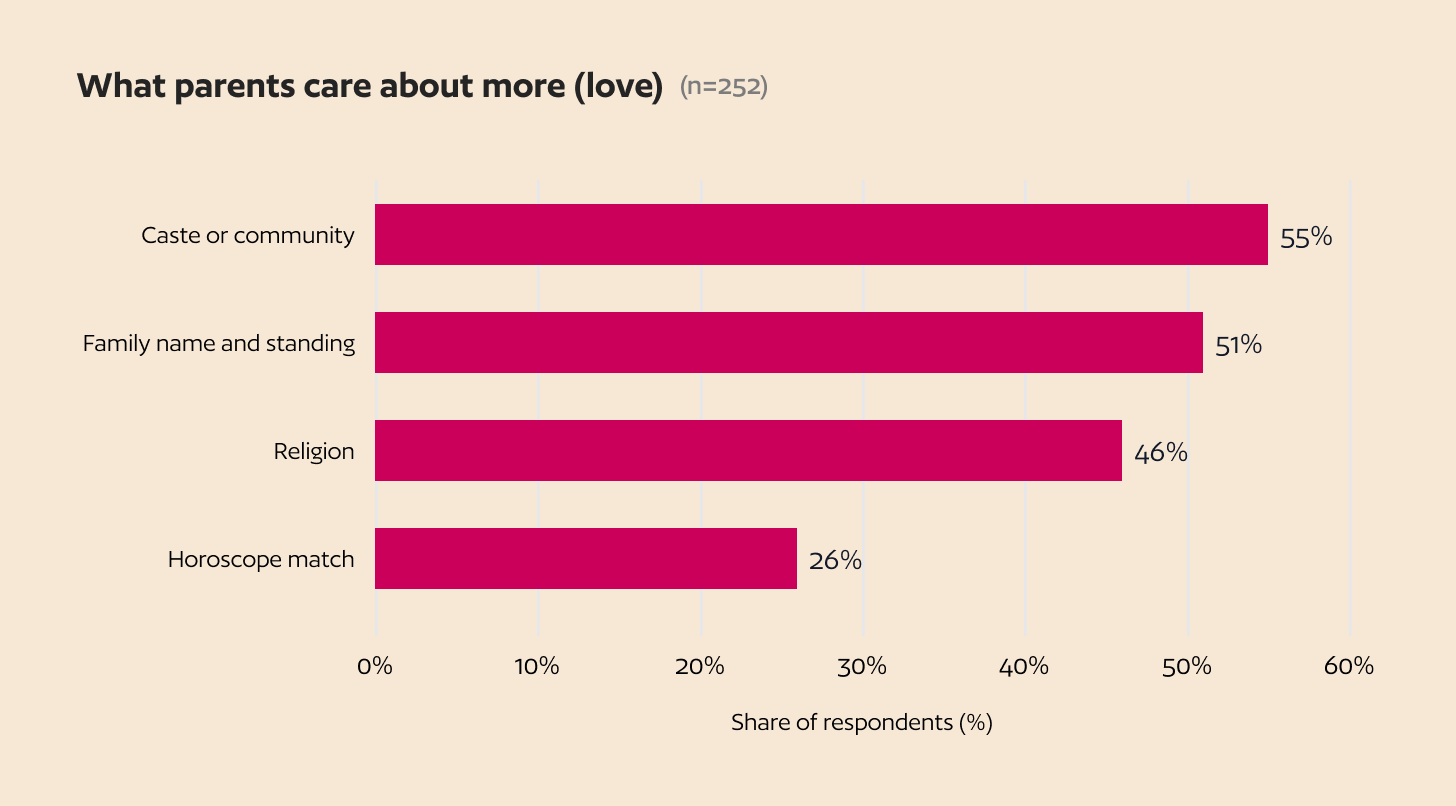
Caste also serves as a shortcut for daily compatibility when two households merge kitchens, rituals, and norms. In Lucknow, Reena Soni, a Punjabi mother whose daughter fell in love with a Brahmin boy, worried less about status than daily life - unfamiliar rituals (“they keep the pallu on the head”) and unexpected dowry norms.
Inside caste sits a Russian doll of even finer filters, from sub-castes that left Chirag Mishra in Indore sighing at “filter on filter on filter” to Bhavna in Jaipur hitting a parental wall in a same-caste love marriage purely over a shared gotra.
Nearly 6 in 10 love-married respondents still married inside their own caste.
The Elastic Band and the Concrete Floor
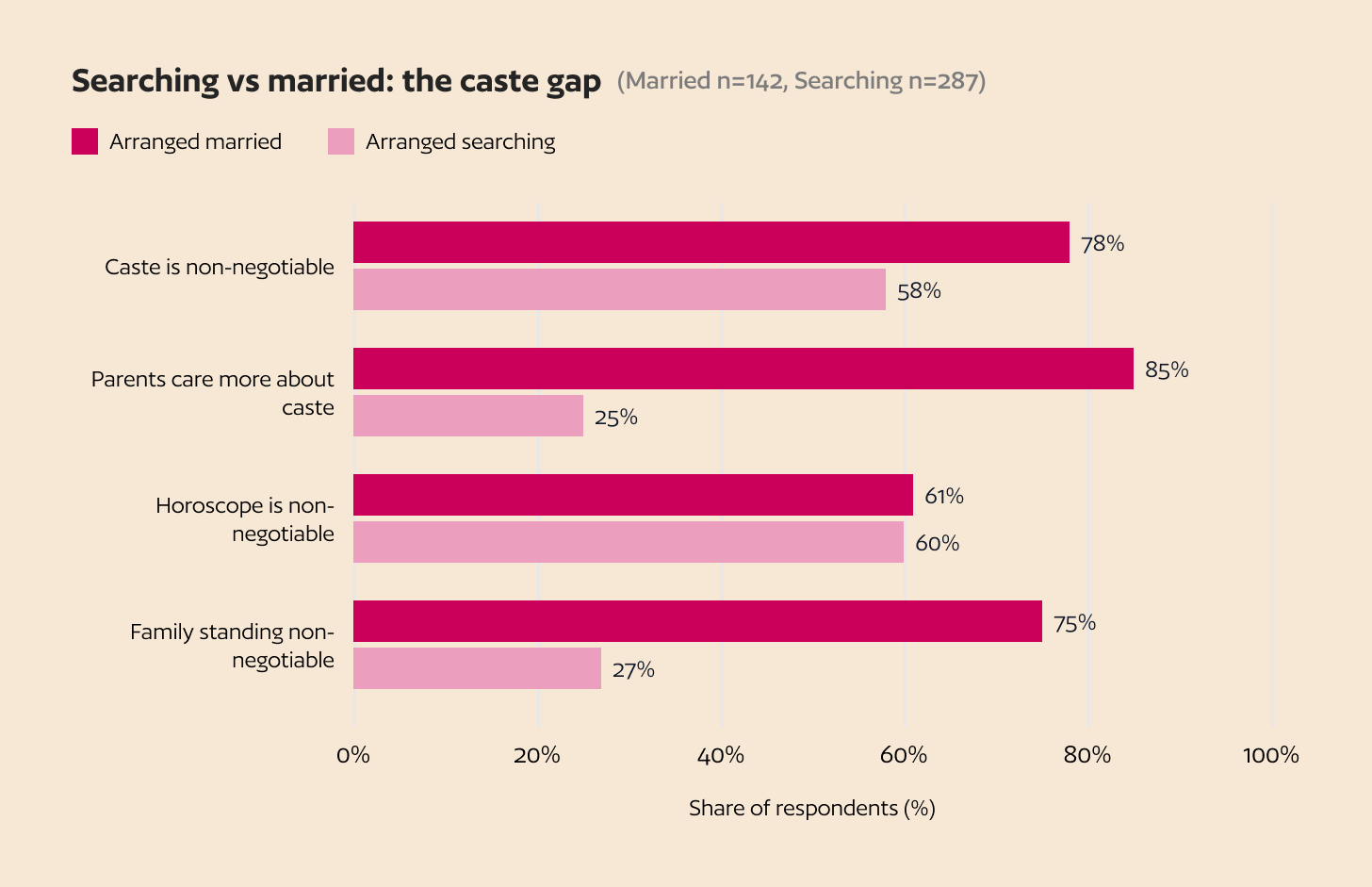
Still, there is a strange contradiction buried in our arranged-marriage data. Among people currently searching, 58% call caste non-negotiable and only 25% say their parents care more about caste than they do. Among people already married , 78% call it non-negotiable, 85% say parents care more—and 97% married inside their caste.
Part of that gap is sample mix (searchers skew older and male). The rest is market reality: time loosens caste, up to a point.
At 24, families shop inside their sub-caste. Past 32, scarcity forces a rethink. In Srikakulam, Teja Boyina sees families with 34-year-old unmarried sons quietly starting to treat inter-caste as an option. And in Jaipur, Karan Rathi’s mother, Manju Rathi, mapped the exact limit. After five years of failing to find a Manglik bride within her Maheshwari community, she opened the gates to Agarwal, Bania, Jain, Brahmin, Jat, and even OBC families.
Then came the floor: “Just [caste name] we are thinking that it shouldn’t be in that. And except for [Religion name].”
We heard that same boundary across North and South India, even from parents who had inter-caste love marriages themselves. Caste in modern Bharat isn’t a solid wall, and it isn’t gone. It is an elastic band stretched over a concrete floor.
Blaming Saturn
If caste is the insurance policy, kundli is the bouncer at the door. Nearly half of arranged searches (47%) require both caste and horoscope as non-negotiable; in love marriage, 44% require neither.
In arranged search, kundli is Gate 1—it runs before two people ever speak. In Indore, Kaveri Agrawal watched matches she actually liked disappear before a single call: scarred by family divorces, her father ran every incoming biodata through a kundli app first and forwarded only the ones that cleared the points.
And yet, listen closely to families who have spent a few years in the market, and you notice kundli doing a second, subtler job. It is the most polite way in India to say no. When profiles arrive through aunts and neighbours, telling a relative “his salary is too low” burns relationship. Blaming the planets costs nothing. In Kadambur, Selvaraj has heard the script for years: “’I will check the horoscope and tell you’ - if we send it, they say, ‘That horoscope is not good.’” Nobody can argue with a planet.
The Art of Bending the Stars
Which brings us back to Karan’s government job - and P. Sivakumar, a father in Vijayawada who explained the whole system with a job-market analogy:
“In an arranged marriage, options are in our hands. If you have ten jobs, you select the good one. If only one job is okayed, you have to do that one only—then you look into how to do it.”
When you have ten biodatas on WhatsApp, kundli is a filter. When your child brings home one partner—or a groom has a government job - you have one option, so kundli becomes a problem to solve.
And Bharat has gotten remarkably creative at solving it. In Visakhapatnam, Kishore Prasad Konjeti (bride’s father) checks horoscopes second, only after liking the boy, fixing minor gaps with prayers so charts don’t “ruin really good alliances.” In Bikaner, Neeta Soni skipped the pandit altogether and simply told her partner’s family, “we got it checked, it’s a match.” In Vijayawada, Sravan quietly introduced an astrologer friend into his girlfriend’s relatives’ circle before revealing the relationship, securing a glowing reading when it mattered. And in Karur, after four years of rejections, Lokesh took his parents to three astrologers for the exact same chart—three contradicting answers finally broke the spell.
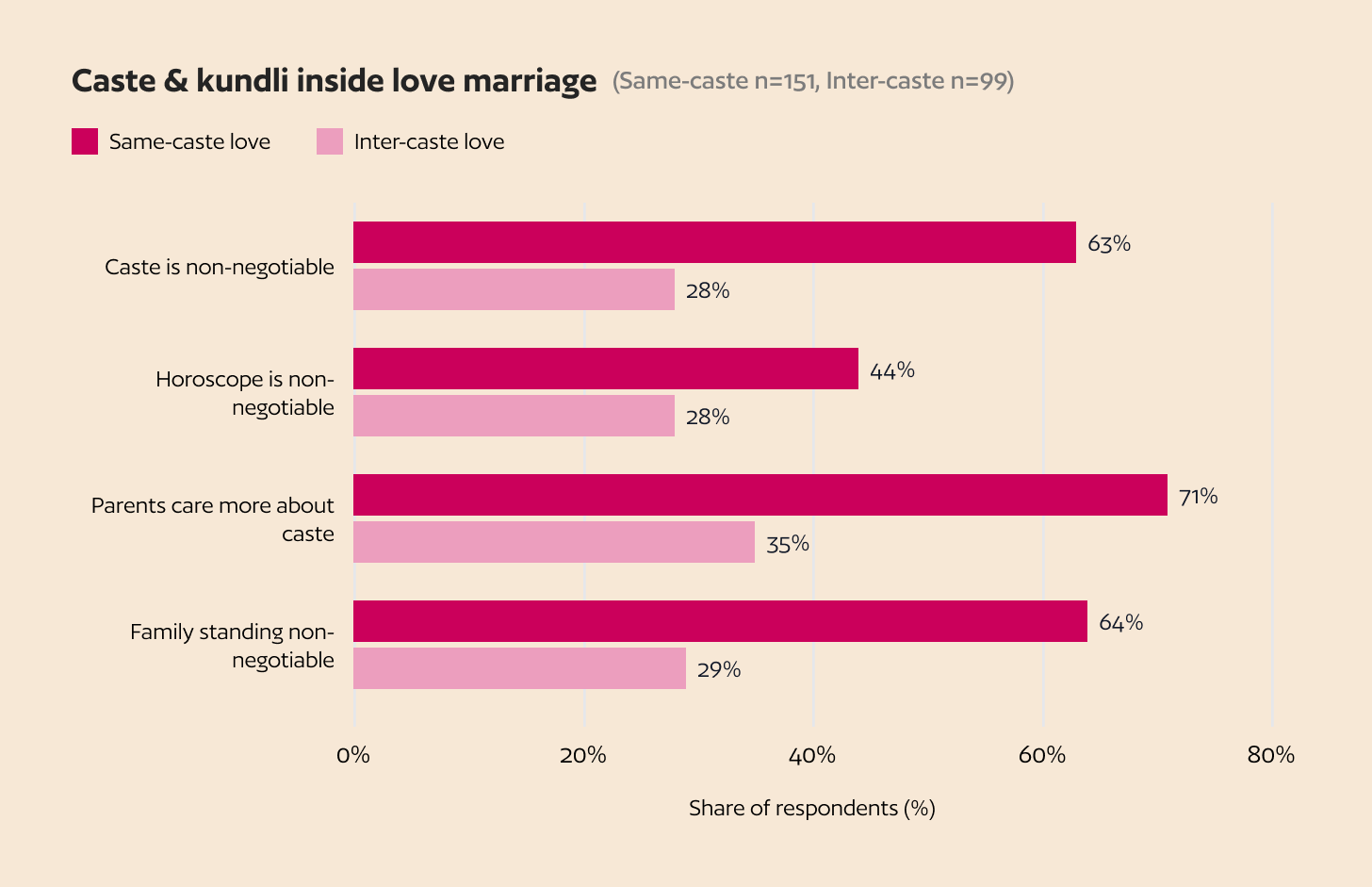
Plenty of families still believe deeply. Yet even in love marriages, breaking one rule eases the second: 44% of same-caste love couples call horoscope non-negotiable, dropping to 28% among inter-caste couples.
Operating Systems for Uncertainty
The mistake most modern observers - and most matrimony apps - make is treating caste and kundli as either sacred absolutes or irrational superstitions. In practice, they are operating systems for uncertainty.
For anyone building for Bharat’s marriage market, four lessons follow. If you want to loosen caste, replace what caste insures with real-world verification and family-level trust. Because families start narrow and stretch with time, design for progressive widening instead of binary caste checkboxes. Rather than using kundli as a Gate 1 kill-switch, treat it as context families can work around once they like the person. And until saying no feels socially painless, build a face-saving exit - or “the horoscope didn’t match” will remain India’s favourite ghosting script.
Rules in Bharat rarely break in public. They bend in private, one negotiation at a time -its either a government job, a long search, or a stubborn couple.
This is Edition 3 of 7 in our series on Modern Marriage: Bharat Edition, with Lokal.
Read the full report - Modern Marriage: Bharat Edition
Editor’s note: All participant names have been changed to protect their identities and confidentiality.
This reminded me of a line of Abhishek Upmanyu's show. Exactly at https://m.youtube.com/shorts/tUmWgRYEoKA