


Do you know which episode of FRIENDS is the highest rated on IMDb? It’s “The One Where Everybody Finds Out” (S5, E14). Monica and Chandler have been seeing each other in secret, and this is the episode where the whole gang finds out about their relationship.
I find it peculiar that, for a show that covered so many life dynamics among the friends, the audience picked this episode as their favourite. FRIENDS makes the audience feel like an extension of the six people on screen. When you discover that two of your pals are going to build a new family, nothing beats that excitement, because building a family is a milestone in anyone’s life.
In the series, Monica and Chandler tell their parents they are getting married as news, not as a request for approval.
Now compare that with Sunil, a sports teacher in Indore. Sunil met his girlfriend in college in 2019, and they grew close over long phone calls during the lockdown. For about five years, only his friends knew. “Friends are more involved,” he told us, “they are the first ones to find out.”
His family heard only when they began pushing him to marry. So he told his mother, because “I talk more to mom; boys don’t talk much to dad.” She said no. One day, while Sunil was out, his girlfriend called and his mother picked up the phone. His mother told the girl, “no need to call after today, stay away from my son.” She never told Sunil everything she said.
So Sunil turned to his elder sister, because “family members listen to my sister more.” She took the phone, asked his girlfriend the polite questions in front of him, and then stepped away to talk to her alone. Afterwards she told him, “the girl is fine, but check the rest.” Sunil said, “no sister, she is the one.” His sister brought their mother around, and his father, who had followed his mother’s no, followed her yes. “If once sister was convinced,” Sunil said, “then sister herself could convince mom.” Their wedding is now fixed.
On FRIENDS, the gang finding out is the happy ending. In Sunil’s house, his friends knowing changed nothing for the marriage. The person who changed the outcome was his sister.
That difference sits at the heart of this edition. Our report with Lokal, Modern Marriage: Bharat Edition, surveyed 263 people in Tier 2 and Tier 3 cities who married for love, and we interviewed couples and parents in Indore, Jaipur, Lucknow, Vijayawada, Coimbatore, Bikaner and Varanasi. I kept asking one question of all that material: when you fall in love in Bharat, who do you tell first, and why that person?

If you only have a minute
In Bharat, you marry into a “we” that existed before you were born. In the West, marriage builds a new family. Here, it joins two existing ones. So the family’s yes stays part of the deal even when you choose your own partner. 73% of love-married respondents needed a parent’s yes, against 53% of arranged respondents.
Friends and siblings do two different jobs. You tell a friend while you are still working out whether this person is right. You tell a sibling once you have decided and need someone to take it to your parents. 58% of people who told a friend first said the decision was “just me”, against 28% of people who told a sibling first.
The sibling route works. When a sibling heard first, 58% of families came round within weeks or a few months. When a friend heard first, 32% did.
How your family finds out shapes how they react. Couples who told on their own terms got an immediate yes 29% of the time. Couples who were caught, or whose messages or photos got out, got one 8% of the time.
Same caste makes it easier. 57% of love-married respondents married within their caste. Same-caste couples told their parents on their own terms 51% of the time; inter-caste couples did so 18% of the time.
What does marriage mean, and to whom?
In the United States, marriage is mostly about two people starting a family of their own. Researchers who compared India and the US put the Western norm this way: “individuals are expected to exercise personal control over their own partner selection” (Bejanyan, Marshall and Ferenczi, 2015). Meeting the parents is a milestone. Their blessing is lovely to have, but it isn’t a requirement.
In India, and across much of Asia, marriage brings two families together. The same researchers describe what follows: “partners commonly date in secret until they are ready to get married, and can then reveal their intentions to their families. However, the decision between the partners does not ensure the prospect of marriage, as both families also have to agree.” You hear the same thing from young women in China. A study in Beijing quotes one of them: “if I am not certain about the relationship, I will not bring him home” (To, 2016).
So Monica and Chandler hide from their friends to dodge the fuss. An Indian couple hides from their parents because the parents still hold a veto.
The “we” you are born into
Robert Cialdini, the psychologist who wrote Influence, describes a principle he calls Unity. His rule is simple: “People are inclined to say yes to someone they consider one of them.” He draws a line between two kinds of closeness. Some people make you think, “that person is like us.” Others make you think, “that person is one of us.” Friends and colleagues usually fall in the first group. Family falls in the second. In his words, being in the same family is “the ultimate form of self-other unity.”
I think this explains a lot about how young Indians handle love. Most of us grow up inside the family’s “we”. The family has a say in the school you go to, the college you pick, the clothes you wear and the food you eat. Your “I” carries a lot of the family’s “we”. Even when parents say they are fine with a love marriage, the child knows the decision will land on the whole household, and on its name.
The survey shows how strong that pull is. I expected love marriages to leave the family out of the decision. The opposite happened:
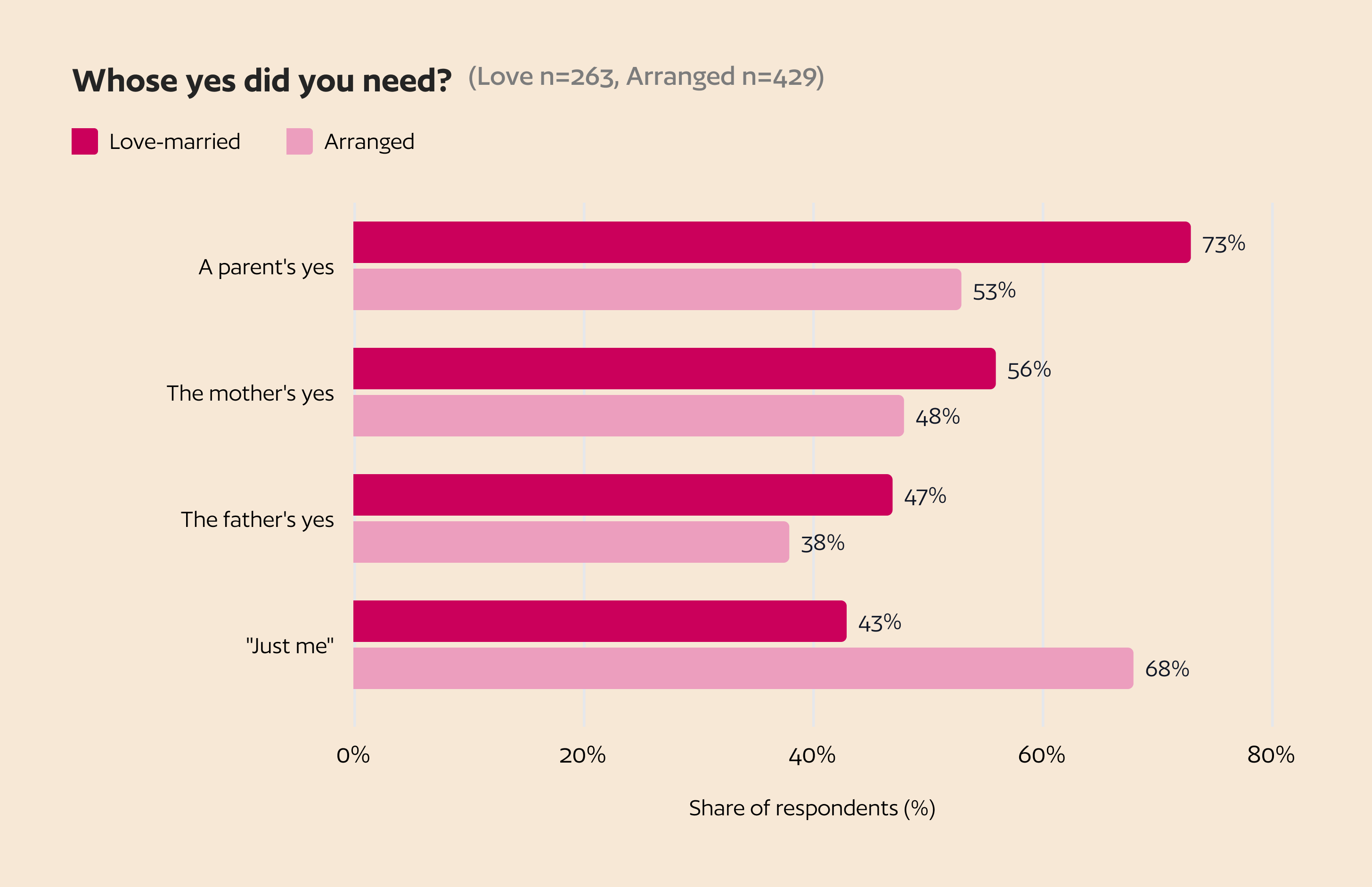
In an arranged marriage, the family has already approved everyone on the list, so the final pick feels like yours. In a love marriage, you chose without them, so you still need their yes after the fact.
Friends come first: am I making the right choice?
For most of your life, your family helped you make decisions. Love is one of the few choices you make alone. It’s hormonal, it’s sudden, and you find yourself drawn to a person before you have thought it through. So you need someone to tell you whether you are choosing well, and most people turn to a friend.
Often you don’t even have to tell them. They figure it out. Ishita, from Lucknow, told us her friend circle “had a very fair idea about us dating... okay, these guys are meeting now, they are going for movies, they are going for concerts.” Sunil’s friends knew for five years before his mother did.
Friends help you judge whether the person is serious, and they coach you through it. During three years of caste trouble, Shubham Singh Kushwah kept going back to a senior’s advice: stay stubborn on one thing, and your parents will agree today or tomorrow.
What friends don’t do is talk to your parents. Among people who told a friend first, 61% said their parents changed their minds only after meeting the partner in person.
Siblings come next: how do I present this to my family?
Once the relationship becomes serious, the question changes. You stop asking whether this person is right and start asking how to present them to your family. For that you need someone the house already listens to, and this is where a sibling comes in.
The survey shows how different the two groups are:
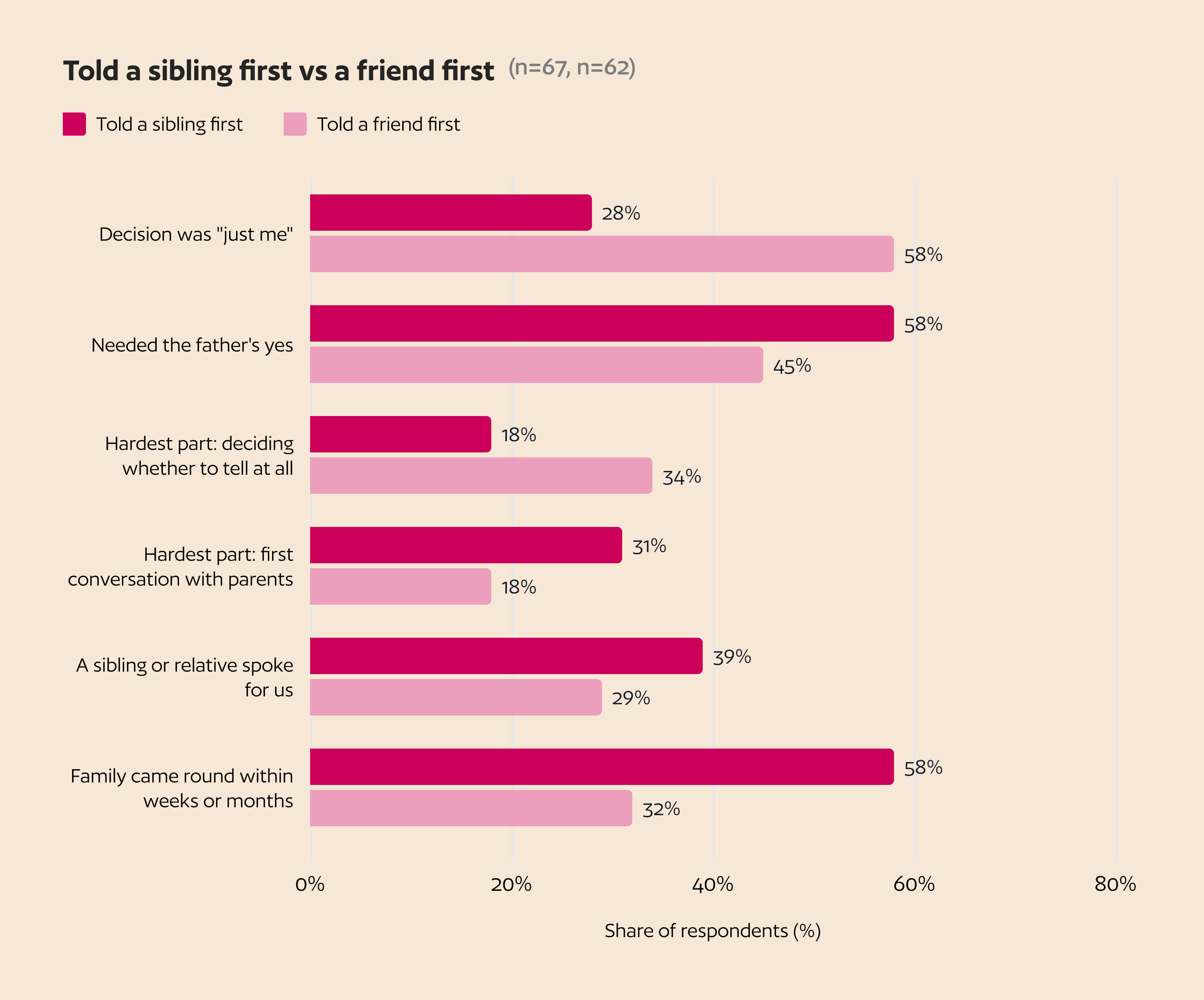
People who told a friend first were still wondering whether to tell the family at all. People who told a sibling first were already working out the conversation.
Go back to Sunil’s sister. She didn’t just carry the message to their mother. She checked the girl first, on her own terms and out of his earshot, and only then put her own word on the line.
We heard versions of this across cities. Shubham Singh Kushwah told his married sister first, because “she got married, I can share everything with her.” She kept coming back from her in-laws’ house to argue his case with their parents. Phani Satya’s brother, working in Australia, paid for his dates through college. Neeta Soni, from Bikaner, went through the women of the house one by one: an aunt first, then her uncle’s wife, and her father last. “I’m so frank with my dad that there’s nothing I can’t tell him,” she said, “but I couldn’t tell him this.”
Birth order decides who even has this option. 41% of youngest children told a sibling first, against 22% of eldest children. If you are the eldest, there is nobody above you, so you go sideways to cousins and aunts.
What if there is nobody to tell?
Not everyone has that support system, and the people without one are often the most scared.
Shubham had his sister. His wife had nobody. “On her side, the problem was that she was alone,” he said. “There was no one to convince them.” Her family was afraid the couple would elope, so they showed her a new boy every month. Sunil’s girlfriend described her own home: “there is no elder one at my home who understands my family.” So it was up to her to decide, and up to her to convince them.
Women in our survey told their parents directly 31% of the time, against 10% for men. Some of that may be courage. I suspect some of it is that many daughters simply have no ally to send.
Simran’s story is the one that stayed with me. She lives in Indore. She told her mother about her relationship herself, and then asked her boyfriend whether he was ready to tell his family. He said, “nahi, gharwale mai kaise bolun?” (No, how do I tell mine?) Her parents had already set one condition: the boy had to be “strong enough to take your stand.” He wasn’t, and the relationship ended. She went back to an arranged search.
Why you can’t spring it on your parents
When parents look for a match, they already carry a picture of the right bride or groom: the community, the family, the job, the city. When you bring someone home, they hold your partner up against that picture almost instantly. If your partner doesn’t fit, the first reaction is rejection.
Daniel Kahneman describes this fast, instinctive thinking in Thinking, Fast and Slow: “the conclusion comes first and the arguments follow.” Once parents form a view, they spend the rest of the conversation gathering evidence to defend it. A sudden reveal gives them one big, threatening fact to start with: my child hid this from me. Everything you say after that has to fight that first impression.
So couples reveal it gradually. The partner first shows up as “a friend”. Phani Satya’s girlfriend used to visit on weekends, and his parents “used to know as a friend.” A mother in Vijayawada admitted she knows the code: “when parents ask, anyone would say ‘friend’, right?” Sravan, also in Vijayawada, spent two years becoming close to his girlfriend’s father, and it worked until the truth came out. “Until I didn’t reveal, till then everything was positive about me,” he said. “From then on everything became a negative feeling.”
Couples also pick their moment. Two chartered accountants in Jaipur waited until both of them had qualified. A young man in Coimbatore kept dropping hints, “don’t search, why are you wasting your time”, until his parents worked it out.
The numbers back this caution:
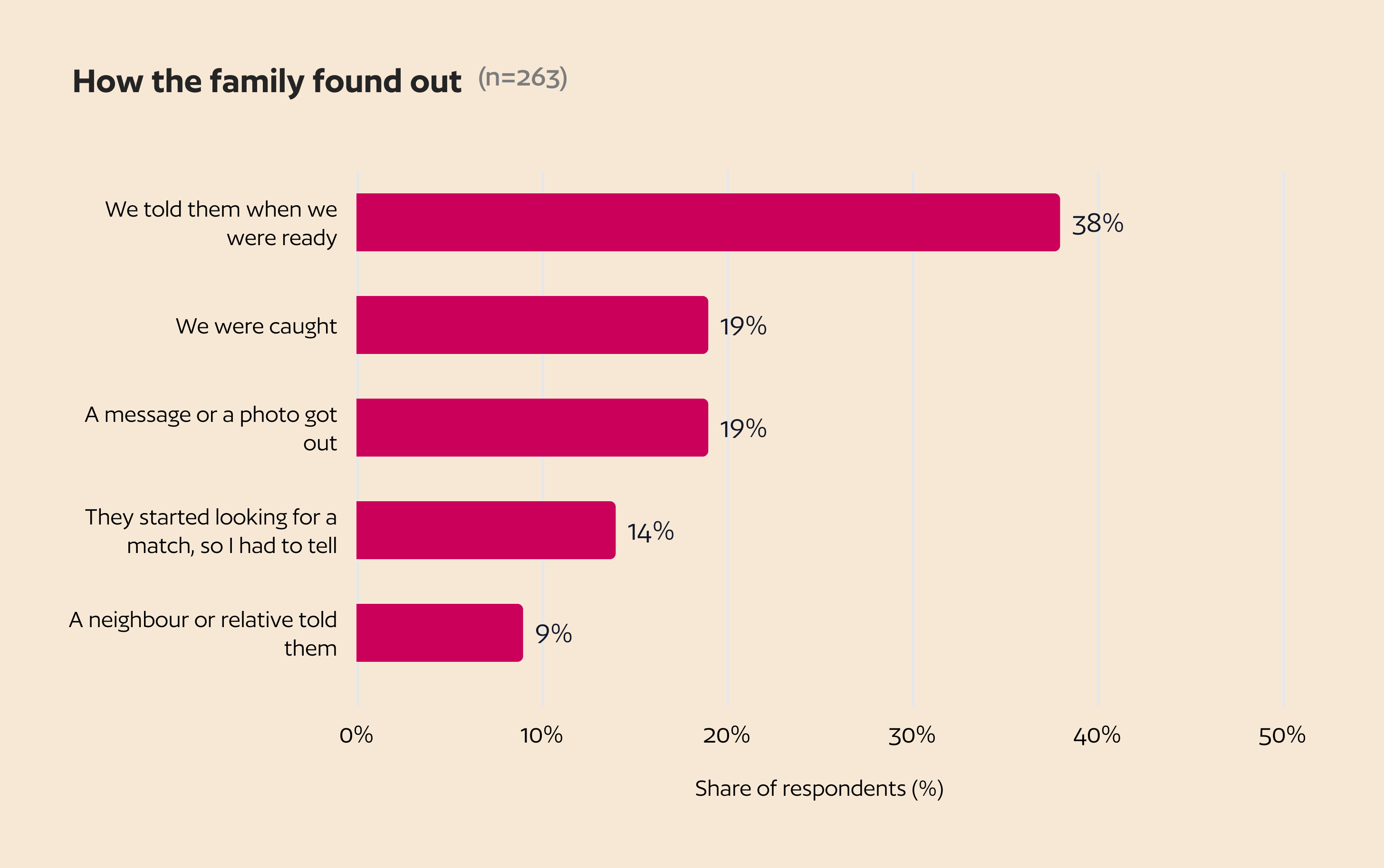
The family’s own search for a match often sets the deadline. Once proposals start coming in, every refusal needs a reason, and sooner or later you run out of reasons. Women hit this wall twice as often as men (18% against 9%). And disclosures forced this way go worst of all: 22% took more than a year, and 17% of these couples say their families still haven’t accepted the marriage.
Same caste vs inter-caste
Many young people want a love marriage, but they also know their parents will never accept someone from another caste, so they fall in love inside the lines. 57% of love-married respondents married within their caste, and 48% called caste a non-negotiable. Sunil told us caste came to mind the moment marriage did: “our caste is same, so it will become a bit easier for us.” Bhavna, from Jaipur, moved fast for the same reason: “since the caste was the same, somewhere we knew that we would somehow convince them.”
Couples who crossed the line had a much harder road:
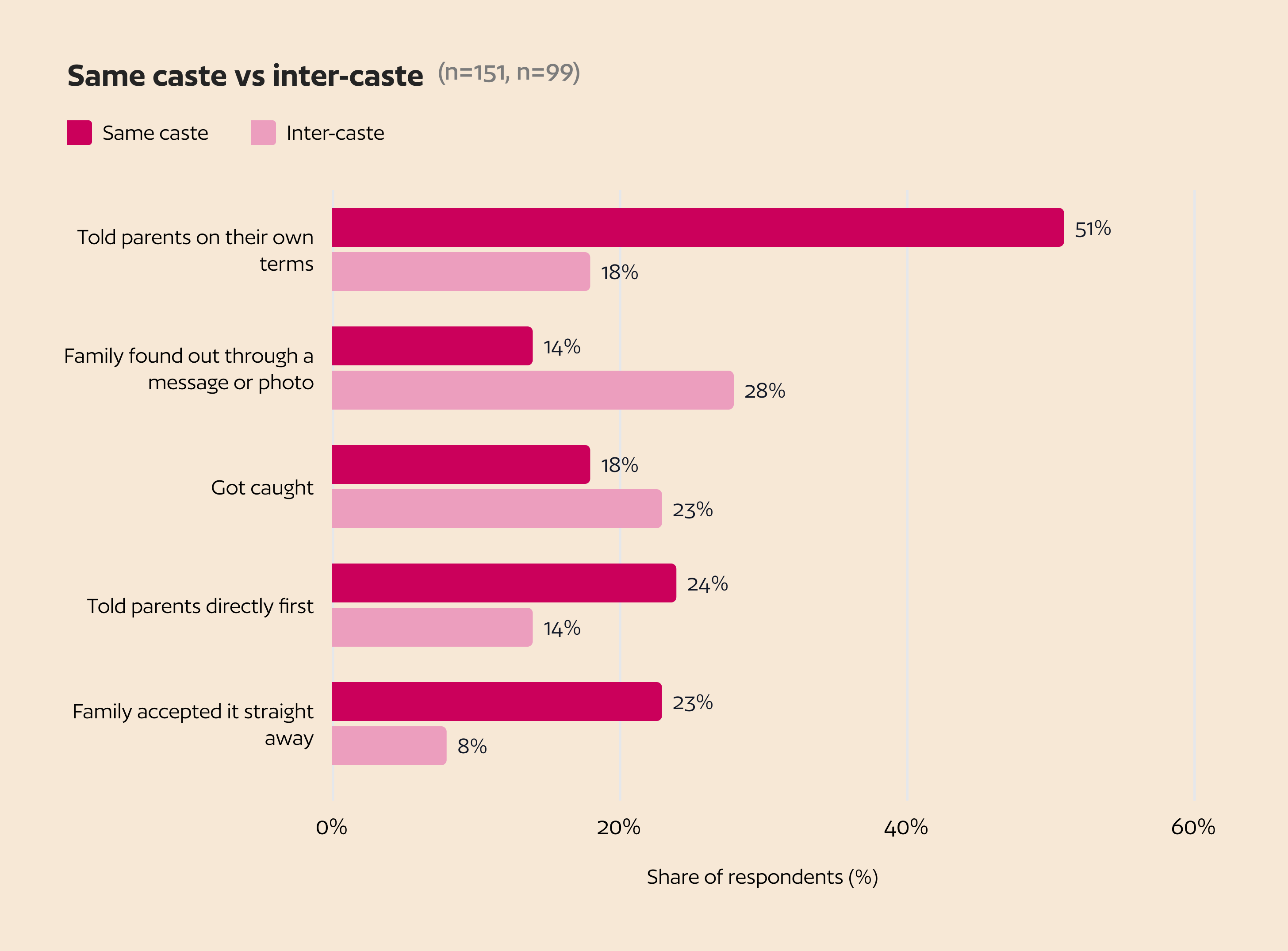
Inter-caste families also worry about people beyond the couple. Shubham’s parents worried about his future children: when they come of age and a match is checked, “they will come to know that your wife is of another caste.”
So what does this tell us?
Go back to FRIENDS one last time. The episode is exciting because the reveal is the payoff. The couple has already chosen, and the friends get the fun of finding out. In Bharat, the reveal is where the real work begins. The couple has chosen, and now the family has to choose too. For that, someone the family already counts as one of its own has to ask on the couple’s behalf.
If you are building for couples and families in Bharat, a few things follow:
Friends and siblings need different kinds of help. A friend helps you answer “is this the right person?” A sibling helps you answer “how do I put this to my parents?” The second question is where couples get stuck: 40% of people who told a friend first wish someone else had done the telling for them.
The family’s search for a match sets the deadline. Anything that helps a couple get ahead of that clock, before proposals force their hand, works on the stage where outcomes are worst.
Parents need a reference point. They judge a love match against their picture of the right match, and meeting the partner changed more minds than anything else (44%). Anything that lets parents see the partner as a person, gradually and before the big conversation, works with how parents actually decide.
Many daughters have no ally. In our interviews, a woman with no elder sibling and a widow’s daughter faced this alone. Women also tell their parents directly three times as often as men.
Read the full report - Modern Marriage: Bharat Edition
Editor's note: All participant names have been changed to protect their identities and confidentiality.
References
Bejanyan, K., Marshall, T. C., & Ferenczi, N. (2015). Associations of collectivism with relationship commitment, passion, and mate preferences: Opposing roles of parental influence and family allocentrism. PLOS ONE, 10(2), e0117374. https://doi.org/10.1371/journal.pone.0117374
To, S. (2016). Making transnational intimacies. The Journal of Chinese Sociology, 3. https://doi.org/10.1186/s40711-016-0032-3